
Searching Hubbard County Criminal Dockets
For a remote Hubbard County criminal docket search, begin at Minnesota Court Records Online Case Search. The tool is known as MCRO. Pick the search mode that fits what you hold: Name, Case Number, or Citation Number. Running a name search? Narrow the court to Hubbard County and choose the Criminal category where offered. The county itself runs no criminal docket database. So this statewide Judicial Branch tool is the online route that matters.
Precision wins here. A full case number beats a fragment every time. The state allows you to drop dashes and leading zeroes but warns against spaces. Hubbard's local style, shown redacted as 29-CR-YY-####, hints at the county element and the criminal case-type element. Treat it as a format clue only. Before trusting a hit, confirm the court location and category. Then check that the filing date and status line up with the case you meant.
- Open MCRO Case Search and choose the search mode that fits the information available.
- For a name search, enter the name and narrow the location to Hubbard County and the category to Criminal when appropriate.
- For a known file, use the complete case number or the preprinted citation number rather than a police report or payment number.
- Open the matching case and read the Register of Actions for filings, hearings, orders, and other recorded events.
- Use Court Administration for a certified copy, a missing public item, or a question the online entry cannot answer.
Minnesota Judicial Branch criminal-help material shows the state-level court context behind these searches.
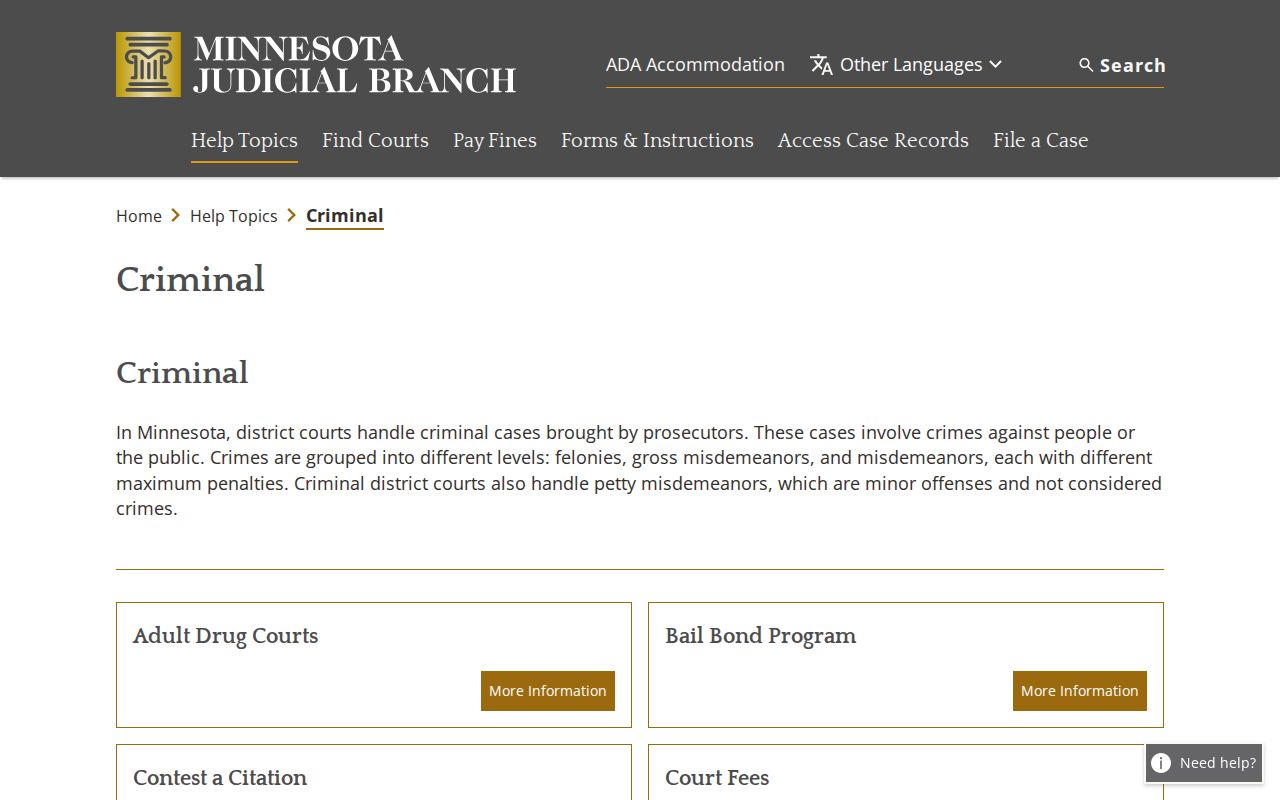
That official resource explains hearing terminology well. For the Hubbard County case itself, the local Register of Actions remains the record that counts.
Hubbard County Criminal MCRO Filters
MCRO goes well past a simple name list. The name search offers last, first, and middle fields. A Sounds Like option and extra filters sit alongside them. After two or more characters, a trailing wildcard can widen a term; the state cautions against pairing that trick with Sounds Like. Filing-date, date-of-birth, case-category, case-status, and court-location controls can shrink a sprawling result fast. Write down which filters you used. A later docket check goes quicker when you can repeat the exact setup.
| Search field | Use for a Hubbard criminal search |
|---|---|
| Name | Start with the spelling shown on court papers; then select Hubbard County to avoid a statewide common-name list. |
| Case Number | Use a complete number for the most direct Register of Actions result. |
| Citation Number | Use the complete preprinted citation number for a related criminal or traffic filing. |
| Case Category | Choose Criminal when the control is offered, rather than assuming all Hubbard cases are criminal. |
The official access overview describes MCRO as a public service with limits. A blank result may just mean a wrong filter, a misspelled name, or a record-access rule. It does not prove that no case exists.
Inside a Hubbard County Criminal Docket
Think of the Register of Actions as the case's timeline. Entries may cover filings, hearing events, orders, judgments, and other court action. It is not a calendar, though, and not a full set of documents. A calendar shows what is scheduled. A PDF may cover one document only. The Register of Actions is the dated spine of the Hubbard County criminal docket. It ties those pieces together.
| Case number | A state identifier, such as a redacted 29-CR-YY-#### pattern, with county, case type, year, and sequence elements. |
|---|---|
| Case category | The Criminal category distinguishes the case from Civil, Family, Probate, or Mental Health search results. |
| Event history | Recorded filings, hearings, orders, and other case events in date order. |
| Hearing setting | A scheduled date, time, location, hearing type, and sometimes connection information. A setting is not an outcome. |
| Document access | Remote document availability when allowed; a public case entry may still have restricted or courthouse-only documents. |
Need an actual paper instead of the event list? Turn to MCRO Document Search with a complete case number. Just know that downloads here are not certified copies.
Hubbard Criminal Calendar and Register
The Hubbard weekly public court calendar is a schedule, not a historical criminal docket. Its fields cover hearing location and date and time. Judicial officer, hearing type, connection type, and case number round out the row. Criminal entries may read Initial Appearance - Rule 8 or Arraignment. Others read Omnibus Hearing, Pre-trial, Review Hearing, or a probation-related hearing. Those labels explain why a hearing is set. They do not reveal whether anyone was convicted, acquitted, or had a charge dismissed.
The local court posts the PDF at 7:00 a.m. on business days. It refreshes the file hourly. Paper calendars in the lobby or outside courtrooms can run newer. Is a future hearing missing? Does it clash with a mailed notice? Call Hubbard County Court Administration at (218) 732-5286 instead of guessing the date moved.
Calendar check: A disappearing or changed calendar line is not a disposition. Confirm a high-consequence date with Court Administration and follow the case-specific notice.
How a Criminal Case Moves
A criminal case can open with a citation, complaint, summons, or charging document. An initial appearance or arraignment may cover the charge, rights, and a plea. From there, the docket may show omnibus or pretrial work, motions, a trial, a plea, dismissal, sentencing, probation, a review, or a contested revocation hearing. Every case takes its own path. Read the calendar and the Register of Actions side by side, and let any filed order confirm what the court actually did.
Criminal docket flow: Filing or charge › initial appearance or arraignment › omnibus or pretrial activity › plea or trial › disposition › possible later review or probation event.
State guidance sketches the broad sequence of a criminal docket. Hubbard publishes no official list of disposition codes. Rely on the event wording the court shows rather than guessing at abbreviations.
Hubbard County Criminal Hearing Terms
Hearing labels invite overreading. One Hubbard criminal calendar can hold an early appearance and a later probation setting in the same case. The terms here describe their practical role, not what happened in any case.
- Initial appearance
- An early proceeding that may cover rights, charges, and plea information.
- Arraignment
- A proceeding where charges are stated and plea or rights issues can be addressed.
- Omnibus hearing
- A criminal pretrial hearing that can address motions, probable cause, rights, or case preparation.
- Pre-trial
- A conference or hearing before trial; its exact purpose depends on the court order and case.
- Probation violation hearing
- A scheduled hearing after disposition that does not itself establish a new conviction.
For a scheduled hearing, the current Hubbard County calendar has the details. For an outcome, go to the Register of Actions, an eligible order, or a certified copy from Court Administration.
Courts That Hold Criminal Dockets
Hubbard County District Court is the general-jurisdiction trial court for the area. It sits in Minnesota's Ninth Judicial District. The court hears criminal matters along with civil, family, probate, juvenile, mental-health, traffic, and related work. Hubbard has no separate municipal court, justice-of-the-peace court, or county court handling criminal dockets. A city or agency may write the citation. But once a case is filed in state court, the District Court route applies.
Hubbard County Court Administration
Hubbard County Courthouse
301 Court Avenue
Park Rapids, MN 56470
(218) 732-5286
Monday-Friday, 8:00 a.m.-4:30 p.m.
Hubbard County's municipalities listing identifies Akeley, Laporte, Nevis, and Park Rapids as incorporated cities.
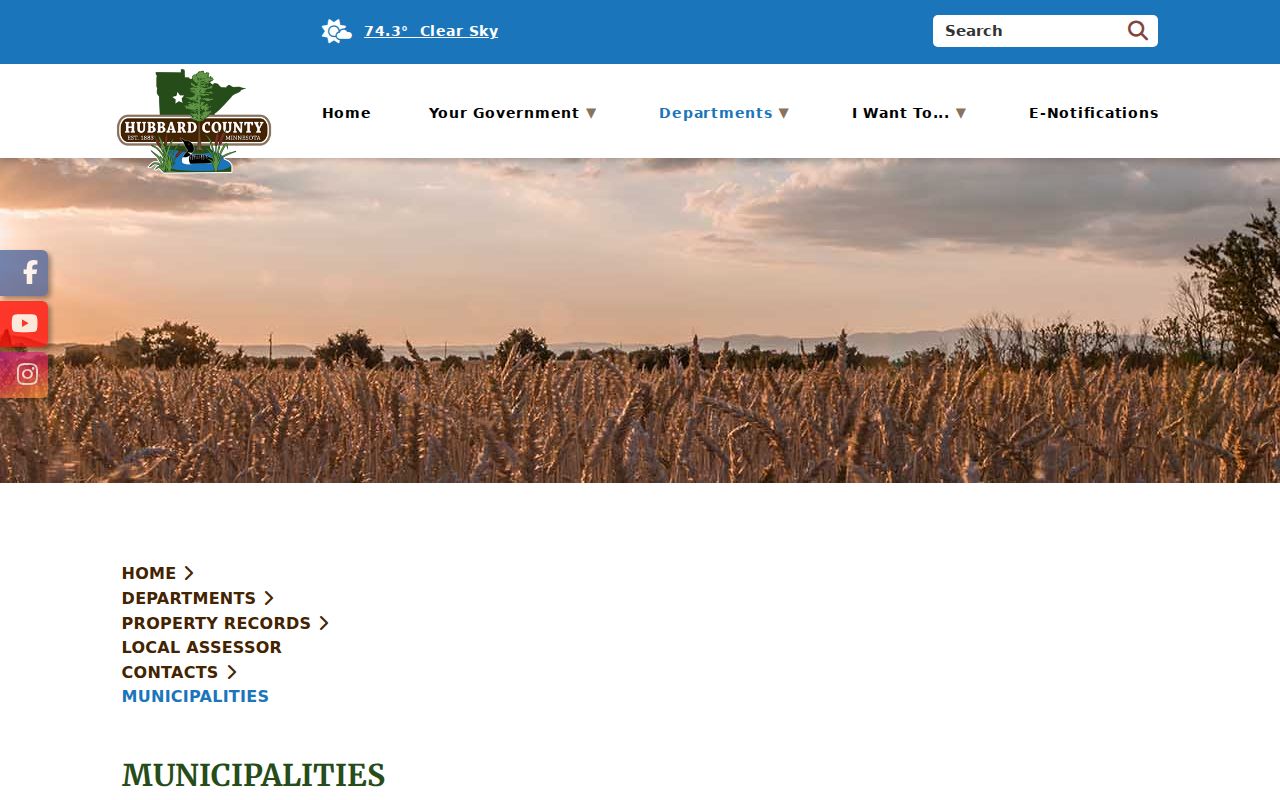
A city office can point you to a local ordinance or agency. It cannot replace the Hubbard County District Court Register of Actions for the criminal docket itself.
Hubbard County Criminal Document Access
Finding a name in a public criminal index is one thing. Seeing the actual document from home is another. For a Hubbard County criminal docket, start with MCRO. Then move to Document Search for anything eligible for remote viewing. Some filings are public on paper but blocked online. In that situation, a courthouse terminal often shows more than remote MCRO does. For file locations and certified copies, ask Court Administration. Confidential or sealed items go through the authorized access process, never a simple phone call. Rule 8 of the Minnesota Rules of Public Access sets these remote-access limits. It also shields certain categories and identifiers from display.
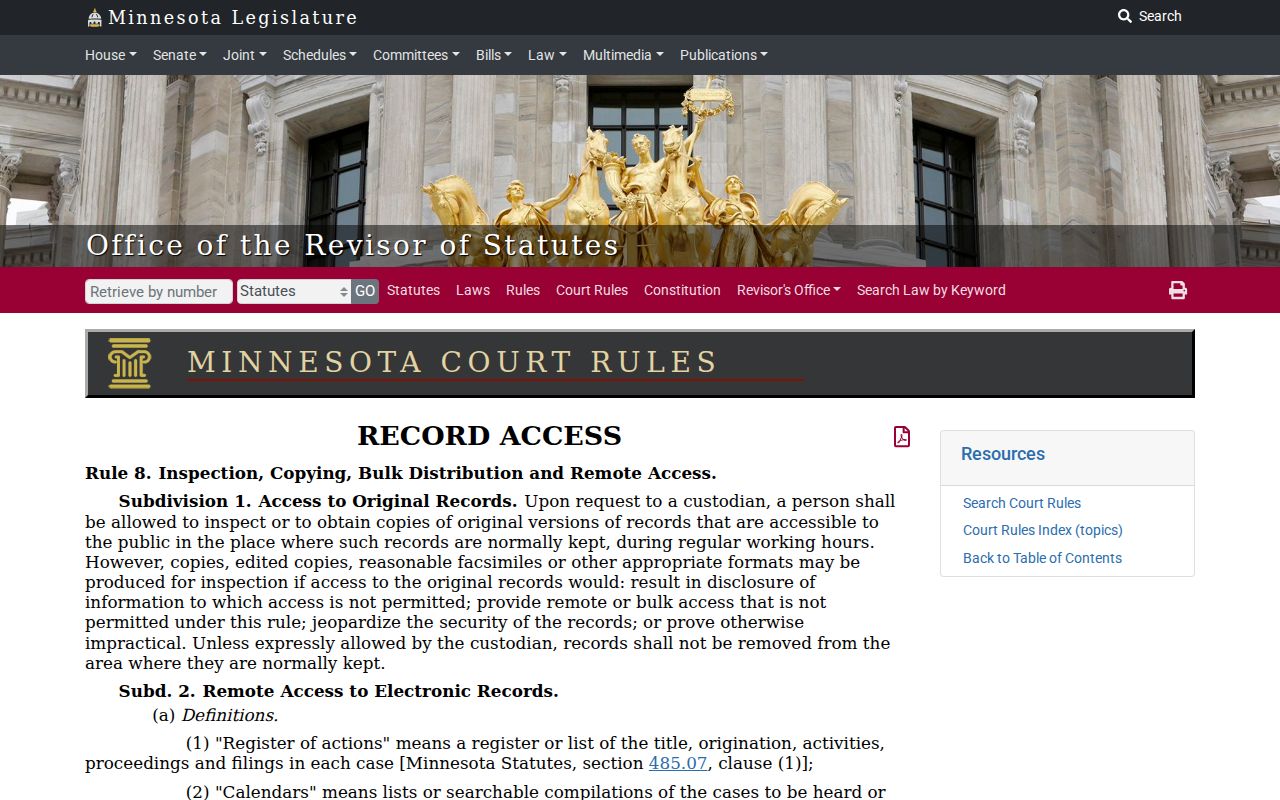
Rule 8 explains the gap. A Hubbard County criminal case can show a full public history at the courthouse while parts stay off limits from a home computer. One caution: a downloaded MCRO document is not a certified court copy.
Sealed Dockets and Public Access
Judicial records in Minnesota follow one rulebook. They are governed by the Rules of Public Access to Records of the Judicial Branch. The Minnesota Government Data Practices Act governs county-agency data, not court files. Rule 4 builds the general access framework. Rule 7 covers access requests and the process for confidential or sealed records. Something missing from a remote docket search has a cause. It may be a protected classification, a redaction, or a document-access rule. That absence never licenses a reader to piece the omitted personal information back together.
Public-access rules:
Rule 4 sets the general public and nonpublic classification framework for judicial case records.
Rule 7 provides the request path for access to confidential or sealed court records.
Minnesota Statutes Chapter 609A supplies the expungement and sealing framework.
Chapter 609A is the official expungement and sealing source reflected in this record-access context.
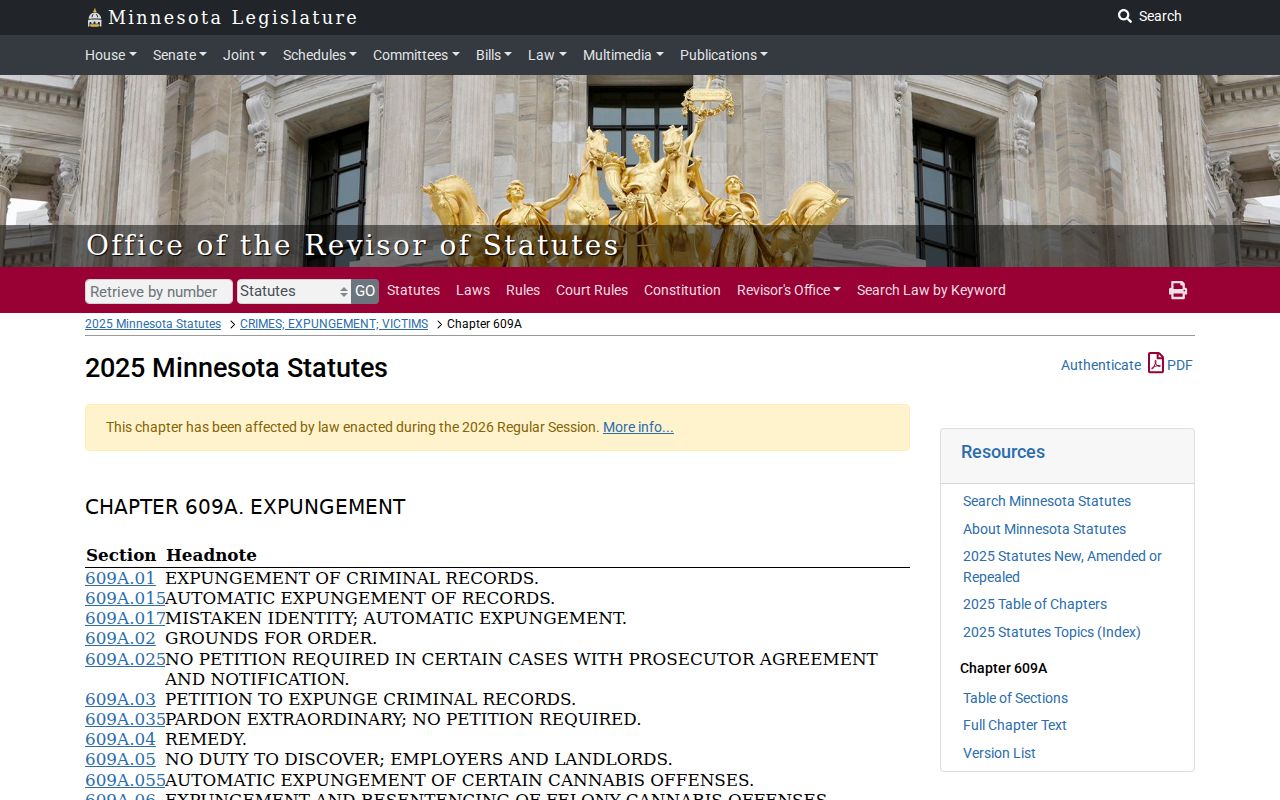
An expungement or access order can change what the public sees. If a Hubbard County record truly matters, confirm its status with the court that issued it. The Judicial Branch's 2025 amended public-access notice lays out the current rules context.
What controls a Hubbard County criminal-record lookup is today's access classification, not the old assumption that every document sits online.
Hubbard County Criminal Federal Records
A Hubbard County case filed in Minnesota District Court is not a federal criminal docket. Searching federal PACER for it gets you nothing. That holds true even if the defendant lives down the road. Federal crimes and other federal matters belong to the U.S. District Court for the District of Minnesota. It runs its own PACER systems. The Minnesota Court of Appeals is a separate appellate route as well. It does not substitute for the local trial-court Register of Actions. PACER's official pricing information spells out the charges for federal records. Those charges follow access policies of their own.
For state criminal records in Hubbard County, rely on MCRO and Court Administration. Turn to the federal system only when the matter was filed there.